
Explore our collection of informative and educational blog posts to stay updated on the latest industry trends and expert advice.
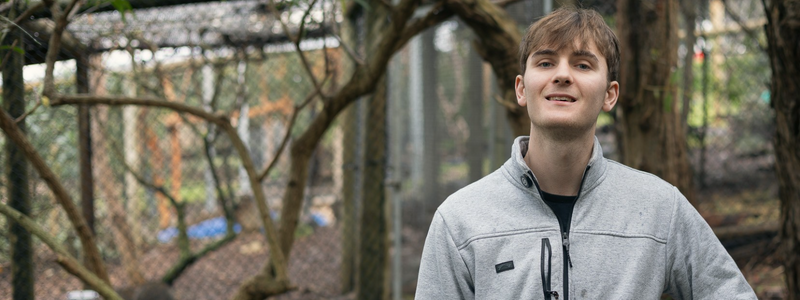
Kyle Gailey can read the fear in a cat's dilated eyes, spot the meaning behind a dog's tucked tail, and calmly scoop up a juvenile lace monitor with the same steady hands you'd use on a baby crocodile. This is what a lifelong love of animals looks like when it finally finds its course.
As part of our ongoing series sharing student stories, we sat down with Kyle to hear straight from him about his study journey, in his own words. From his lifelong love of animals to how he's made online study work for him, Kyle's story is a great example of finding the right course, the right support, and the right fit.
As a child, he read a dictionary of mammals cover to cover and memorised an entire reference book on horses and other equine animals. That early fascination never faded, and today Kyle is studying his Certificate in Animal Care with Open Colleges, guided by his trainer and assessor, Sharon Cliffe.
Originally from Arizona ("the bottom left" of the Four Corners region, as he puts it), Kyle spent a year or two in New South Wales before settling in South Australia, where he's lived since he was around 18. He now calls Adelaide home.
A Lifelong Connection to Animals
Kyle's passion for animals has only deepened with age. He describes a particular bond with certain species (snakes, birds, and reptiles among them) that goes beyond simple interest.
"I have a connection with certain animals," he explains. "If it were a snake I was holding, or a bird I was interacting with, like a rainbow cinnamon lorikeet, that compassion for animals in general is what brought me to study this course."
Kyle, who has autism spectrum disorder (diagnosed between the ages of 8 and 12), found that while he'd always excelled at maths, his real strength turned out to be something different: an ability to connect with and empathise with animals. That realisation shaped the direction of his studies.
Why Open Colleges?
Flexibility was the deciding factor for Kyle. Having done much of his earlier education online, studying from home just made sense and it's a big part of why online study with Open Colleges works so well for him.
"I like to do things at home, without travelling to the city for school or to TAFE," he says. "Growing up, I was doing online school for most of my education, and I found that carried over and having more flexibility with schooling options actually makes it more worth it. And if the price is in the same range, then that's hooray, huzzah - that's awesome."
For Kyle, being able to study on his own terms, in his own space, at his own pace, removes a lot of the friction that a traditional classroom setting can bring. He's able to build a routine around what actually helps him learn, rather than fitting himself into someone else's timetable. That flexibility has also meant he can lean on the right support when he needs it, without the pressure of a fixed classroom environment. His support worker, for instance, helps him slow down and unpack exactly what a question is asking - something Kyle says has made a real difference to how he approaches assessments.
It's this combination: flexible, self-directed study - paired with responsive support from both his trainer and his support worker - that Kyle credits with helping him find his footing and start succeeding in the course.
A Trainer Who Doesn't Give Up
Although this is Kyle's first course with Open Colleges, he's been impressed by the support he's received from his trainer, Sharon Cliffe.
"She's direct but also careful, and she values precision," Kyle says. "She isn't inflexible or stubborn like some teachers I've had - for the sciences in high school, for instance. She doesn't really give up on her students, which is good, and very practical."
A Turning Point: Domestic Care of Dogs and Cats
Ask Kyle about his favourite part of the course so far, and he doesn't hesitate: domestic care of dogs and cats.
"I found that eye-opening," he says. After a slow start to the course, this unit became a turning point. Kyle went from struggling to consistently scoring 98-100%. He learned to read canine and feline body language, from what a tucked tail signals in a dog to the signs of a frightened or threatened cat, including dilated eyes. He also studied the different life stages of cats and dogs, coat types, and breed characteristics.
It's this unit - successfully completing domestic care of dogs and cats - that Kyle points to as his proudest moment in the course.
Studying with Autism: The Role of Support
Kyle is open about how his support worker has helped him navigate the more challenging parts of the course.
"My support worker helps me by reminding me to look at the question and examine more closely what it's actually asking," he says. He recalls one particularly tricky assessment involving a feeding chart, where the question wasn't asking for a date as he'd first assumed, but something else entirely. "That was probably the hardest problem I had."
A Typical Study Day
Kyle's study routine is built around structure and sensory balance. A typical session runs two to three hours of note-taking and reviewing slides, punctuated by short breaks - stepping outside, listening to study music, or having a cup of tea.
"It helps to have a bit of decaf or caffeinated tea when studying," he says. "It's about moderation, and staying healthy mentally, physically, spiritually, emotionally."
Over time, Kyle has also refined how he takes notes, focusing not just on species names but on visual details - pairing notes with images to help information stick. He credits this, along with learning to manage his time efficiently, as key to making the course more manageable as it progressed.
It's a fitting snapshot of how far Kyle has come: a student who once struggled to find his footing now has a study rhythm that genuinely works for him. But the classroom and the study desk are only half of Kyle's story! The other half happens out in the field - hands-on, with real animals, in the moments that don't show up on a slide deck.
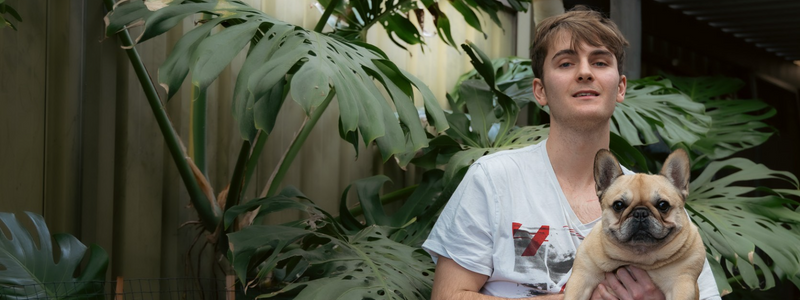
That's a look at how Kyle found his course and made it work for him. In part two, we follow Kyle out of the classroom and into work placement, volunteering, and life at home with his own animals (including a bearded dragon with a mind of his own).
Inspired by Kyle's Story?
If you share Kyle's passion for animals and are looking for a flexible way to turn that passion into a career, our Animal Care course could be your first step. Study online, at your own pace, with the support of experienced trainers every step of the way.